
In over 15 years of executing full-stack digital marketing strategies for thousands of websites, our team has rarely seen a topic spark quite as much chaotic industry debate as AI search optimization.
The internet has been flooded (once again) with self-proclaimed gurus claiming (once again) that "SEO is dead"
Well, Google officially weighed in and put the argument to rest.
More...
In this post, we’re going to set aside the hullabaloo and panic.
We’ll instead focus on the economic and technical realities of how search and AI tools actually work, backed up by industry veterans.
More importantly, we’ll lay out the high-leverage actions real estate operators need to take to ensure their assets are accessible and recommendable across every modern search engine and AI model.
With the release of their official AI Optimization Guide, Google made their stance clear and challenged many of the claims currently circulating around AI optimization.
The “SEO is dead” claim has been made (literally) tens of thousands of times since the early 2000s.
People claiming this want you to believe that traditional search is no longer relevant.
They want you to believe you need to buy expensive, specialized retainers to optimize for AI SEO, GEO, AEO, or any other derivative of AI optimization.
But according to Google and leading industry experts, AEO and GEO are just SEO done really well with a few extra steps.
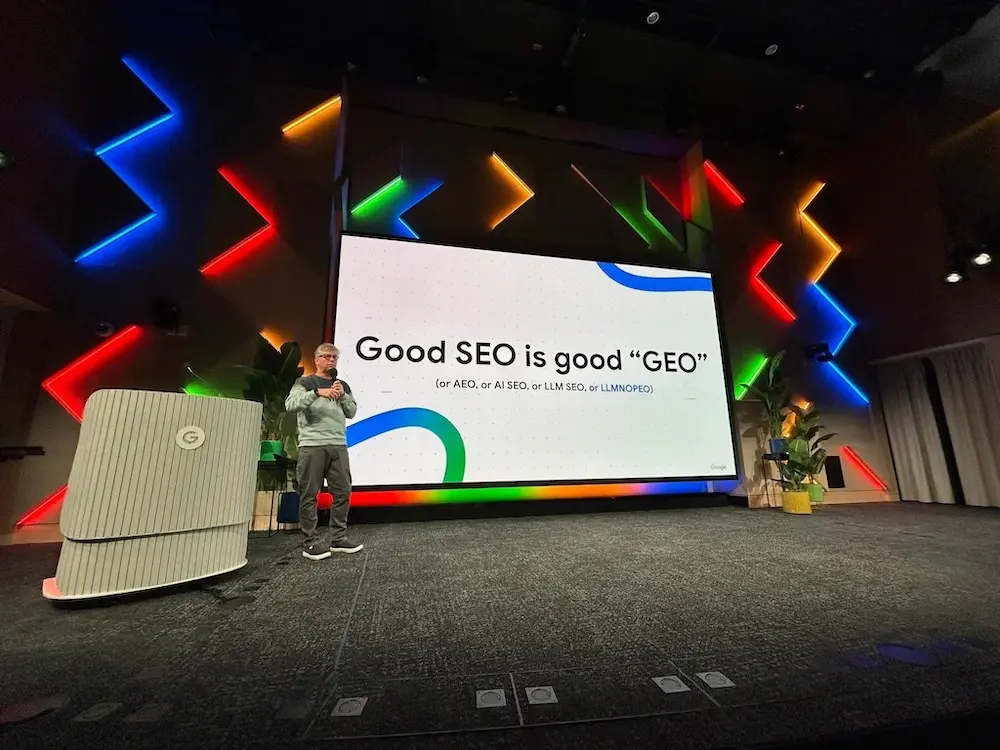
Source - "A Day at Google" by Daniela Furtado
So if it’s all just SEO, where did all of these other names come from?
And why are they being thrown around by everyone?
The Trap of Shiny Object Syndrome
The marketing industry is fundamentally addicted to creating new acronyms.
With every iteration of new technology, people come out of the woodwork to invent a brand-new vocabulary.
They do this to sound smart, induce panic, and sell repackaged solutions.
This tactic is successful because it triggers both:
- 1The amygdala (the primitive part of our brain that processes fear and panic)
- 2Our dopamine pathways (which make us crave novelty)
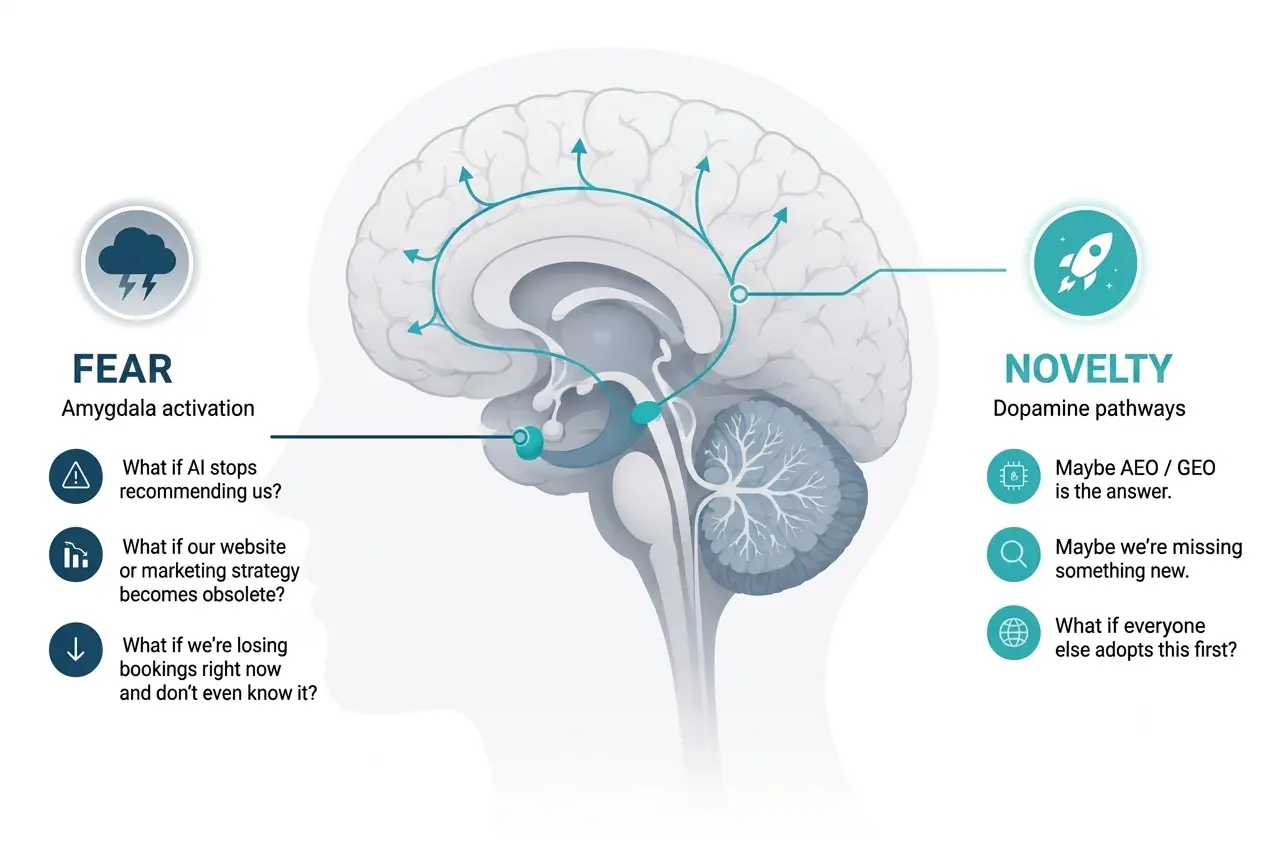
By convincing you that your current strategy is obsolete, they trigger a Fear of Missing Out (FOMO).
By convincing you that there's a new shiny toy that will solve all of your problems, they push the novelty button.
In most cases, these narratives create demand for services that either aren't necessary or are not meaningfully different from established SEO practices.
Understanding these psychological trigger points is actually really good marketing.
The problem becomes when it's manipulative by inventing and communicating solutions for problems that don't exist in reality.
It's one of the main reasons the marketing industry gets a bad rap, even though there are plenty of experienced, qualified marketers doing great, honest work.
Experienced marketers have seen this cycle repeat many times.
We’ve seen the same hype cycle with:
Some of these things lasted. Some didn't.
But they all had insane amounts of hype followed by a period of normalization or they slowly faded away till people forgot about them.
The most poignant example might be the feverish NFT craze of 2021.
Where are those multi-million dollar digital tokens now?
They were immediately thrown into a box the minute a newer, shinier toy called AI arrived.
To be fair, AI is an incredibly powerful, enduring piece of technology that is absolutely here to stay.
But just like smartphones, it will eventually shift from the shiny object it is now into a standard, everyday utility that people take completely for granted.
The Tom Brady Rule of Digital Marketing
When a new technology like AI disrupts the market, you have to decide who you are going to listen to.
How many ads have you seen on YouTube or Facebook (or everywhere else) touting “AI this” and “AI that”?
It’s everywhere!
And it can be difficult to decipher who is worth listening to and who isn’t.
Who Will You Listen To?
To use a football analogy (because we love football), are you going to take advice from a local high school coach who has never won a title?
Or are you going to listen to Tom Brady and Patrick Mahomes, who both have multiple Super Bowl rings?
We choose to ground our work on the "Tom Bradys" of digital marketing.
These folks are the undisputed industry heavyweights who have spent the last 20 years being consistently right.
They have data and case studies out the ears and their frameworks make complete logical sense.
Above all, they pursue this craft (digital marketing) as their life’s mission, and they are incredibly good at it.
Our approach is to look at official statements from the platforms + the consensus from established practitioners such as those listed below:
The Heavyweight Consensus:
Stop Panicking About AEO / GEO
Don't take our word for it. See how the industry's top minds view the AI marketing craze.
Click the link(s) in each expert's section to look at the active data, case studies, and strategic breakdowns:

Rand Fishkin
Founder of Moz & SparkToro


Lily Ray
Founder of Algorythmic | VP, SEO & AI Search at Amsive

Aleyda Solís
Founder of Orainti & SEOFOMO

There is an ironclad rule we follow at Falcon Ridge Digital, and we recommend you adopt the same:
We place significantly more weight on practitioners whose strategies have survived multiple platform shifts, algorithm updates, economic cycles, and technology disruptions.
In digital marketing, many tactics look brilliant for six months. Some even look brilliant for 1-2 years.
The real test is whether they still work after a decade of change.
That’s why we put our trust in true experts who have spent years navigating multiple generations of search, paid ads, analytics, consumer behavior, and more rather than those whose experience is limited to a single platform or trend cycle.
Consider This
How would you evaluate a commercial real estate advisor?
Would you place more trust in someone who obtained their license six months ago and has yet to sell a house...
...Or someone who has successfully sold hundreds of properties, navigated multiple market cycles, interest rate environments, legal issues, transaction types and more?
Digital marketing is no different.
Experience doesn’t guarantee expertise, but surviving multiple technology cycles often reveals which strategies will stand the test of time and which were merely temporary trends.
Digital marketing is a very interconnected discipline.
Many newer specialists are highly knowledgeable within their specific channel, but real estate operators should remember that business performance is rarely driven by a single channel alone.
Occupancy growth depends on how organic search, paid ads, conversion tracking, CRM systems, attribution, automation, reputation management, analytics, customer experience and more work together.
That’s why we generally encourage operators to seek advice from practitioners who understand the entire system rather than only one component of it.
Shameless Plug
Even many battle-tested marketers don’t fully understand how digital marketing connects to asset profitability because they’ve never owned real estate outside their own home.
Because we are active investors ourselves, we completely understand your journey and we speak your language.
That’s a major reason we focus heavily on the financial realities of real estate in digital marketing, like showing you why Data Sovereignty matters or how to refuse to pay the Middleman Tax so your property can be more profitable.If you need a partner who truly understands your business model and knows how to solve your occupancy problems, click the button below and let's talk
Back to business.
When the actual heavyweights agree that the underlying foundation of search hasn't changed, it’s time to sit up and pay attention.
Below is an excellent breakdown from Dennis Yu, one of the longest-tenured and most influential voices in our space, on why it's impossible to do "AI SEO".
Take a look:
Main Takeaway: If a "secret AI optimization formula" is being pushed, it can be safely ignored.
As Dennis mentions, the game hasn't fundamentally changed.
There are just more layers to it now.
The tech engine has simply gotten smarter and better at summarizing data.
Follow the Money: The Economics of Ads vs. Organic
The most common argument we hear on LinkedIn from cynical marketers is something to the effect of:
“Google is a publicly traded, shareholder-driven company. They’re only looking out for what is best for them, not you as a website owner. You can’t trust what they’re saying because they just want what makes them richer at the end of the day.”
This statement does hold some truth.
Google is (like all companies) looking out for themselves and their shareholders.
But the blanket cynicism taken to these extremes completely ignores basic corporate incentive structures.
You have to look at how the platform actually monetizes to understand when to push back and when to lean in.
The Paid Ads Sandbox
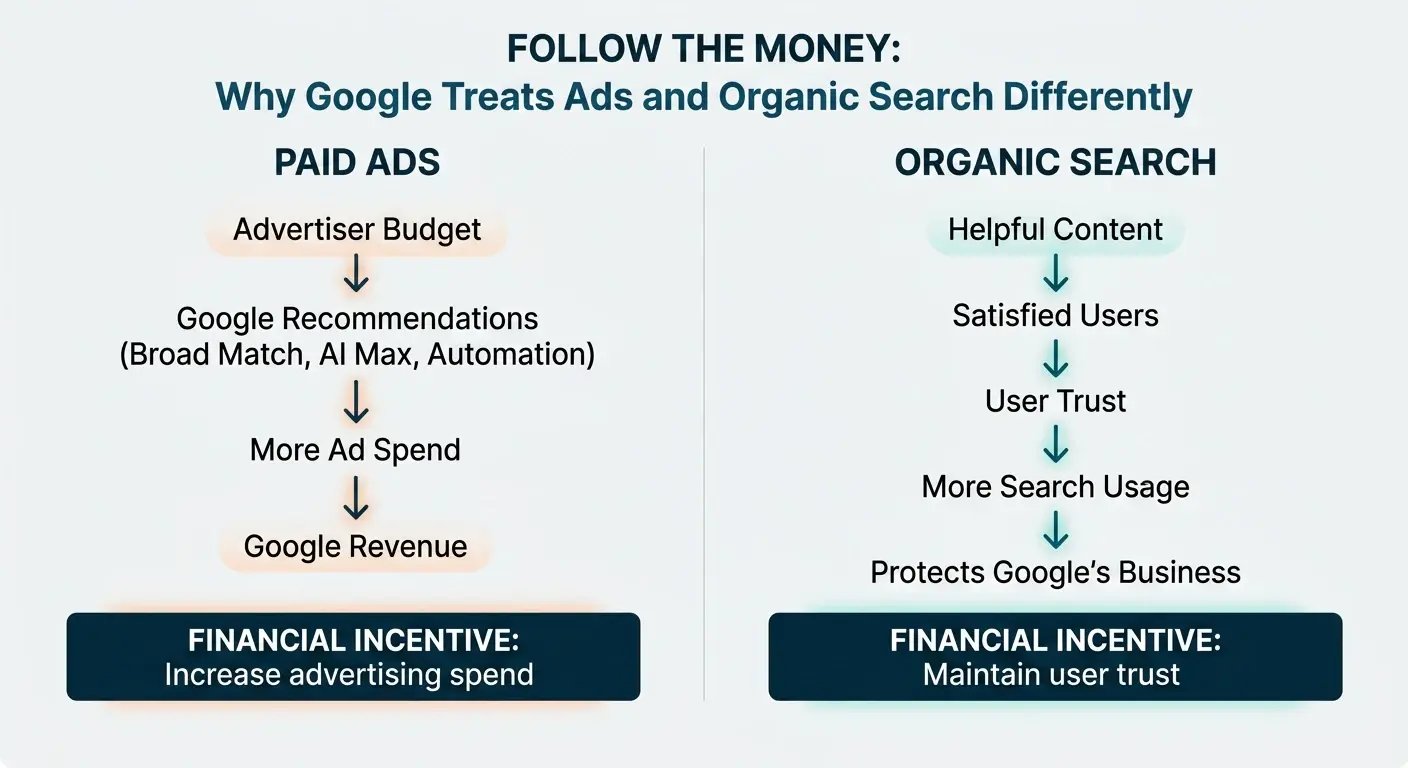
In Google Ads, the platform is highly incentivized to increase your ad spend to hit corporate revenue targets even if your performance doesn’t improve.
This is why their entry-level reps and automated account recommendations will endlessly push you to adopt broad match keywords, AI Max and others.
They claim it "expands your reach and helps the system find relevant results."
In reality, experienced Paid Ads managers have seen these recommendations turn into budget-killers, increasing ad spend and your Customer Acquisition Cost (CAC) far faster than they improve qualified leads or grow your revenue.
They inflate your costs, blow through your ad budget, and bid on highly irrelevant searches before ever finding a qualified tenant or guest.
Skepticism on these recommendations is 100% justified.
But the same is not true for organic search.
The Organic Search Engine
The fundamental difference is that organic search operates on a completely different economic model.
Google makes $0 in direct revenue from anything organic.
Their organic engine's sole value is maintaining absolute user trust by helping them solve their problems quickly, accurately, and efficiently.
If Google provides a bad organic experience, people lose trust and migrate to platforms like Perplexity, ChatGPT or Bing.
Without humans looking for solutions in organic answers, Google loses the attention game and its multi-billion-dollar ad machine collapses.
Google’s stated mission is to:
“Organize the world’s information and make it universally accessible and useful.”
On the surface, it's a nice sentiment.
But nobody truly appreciates how difficult that is to pull off (especially in the era of AI).
The costs of running AI models, then summarizing and displaying those AI results is absolutely staggering.
The Real Cost of AI Processing
Processing a generative AI search query requires insane amounts of computational power.
Industry data shows it costs Google roughly 10x more in server energy and processing power to generate an AI answer compared to a traditional keyword search.
Because of these massive infrastructure costs, Google genuinely needs clean, authoritative, and accurate data that is organized to minimize their retrieval energy.
When your real estate website uses clean, direct content blocks, you make it significantly cheaper and faster for their Large Language Models (LLMs) to scrape and summarize your data.
Clean SEO saves Google billions of dollars in computational energy.
When they tell you that AI isn’t separate from their core index, they have very little incentive (financial or otherwise) to lie to you.
As the video from Dennis points out, AI is just a retrieval layer on top of the same core infrastructure that great SEOs have been optimizing for all along.
The Infrastructure Reality: ChatGPT and Claude Aren’t Special Exceptions
Another common objection is usually:
“Ok fine, maybe that’s true for Google and Gemini, but platforms like ChatGPT, Claude, and Perplexity are independent models, so they require completely different optimization steps.
And with ChatGPT owning the majority of the AI market share, we’ve got to optimize for what they require.”
That’s absolutely true on the surface.
But it also comes with a fundamental misunderstanding of how all of the wires connect, which means you can very easily be optimizing for the wrong thing.
Building, maintaining, and continuously crawling a multi-billion-page web index costs tens of billions of dollars a year.
It’s horrifically expensive.
AI tools that are not built on existing search indexes generally don’t have the capacity (financial or technical) to maintain entirely independent indexes.
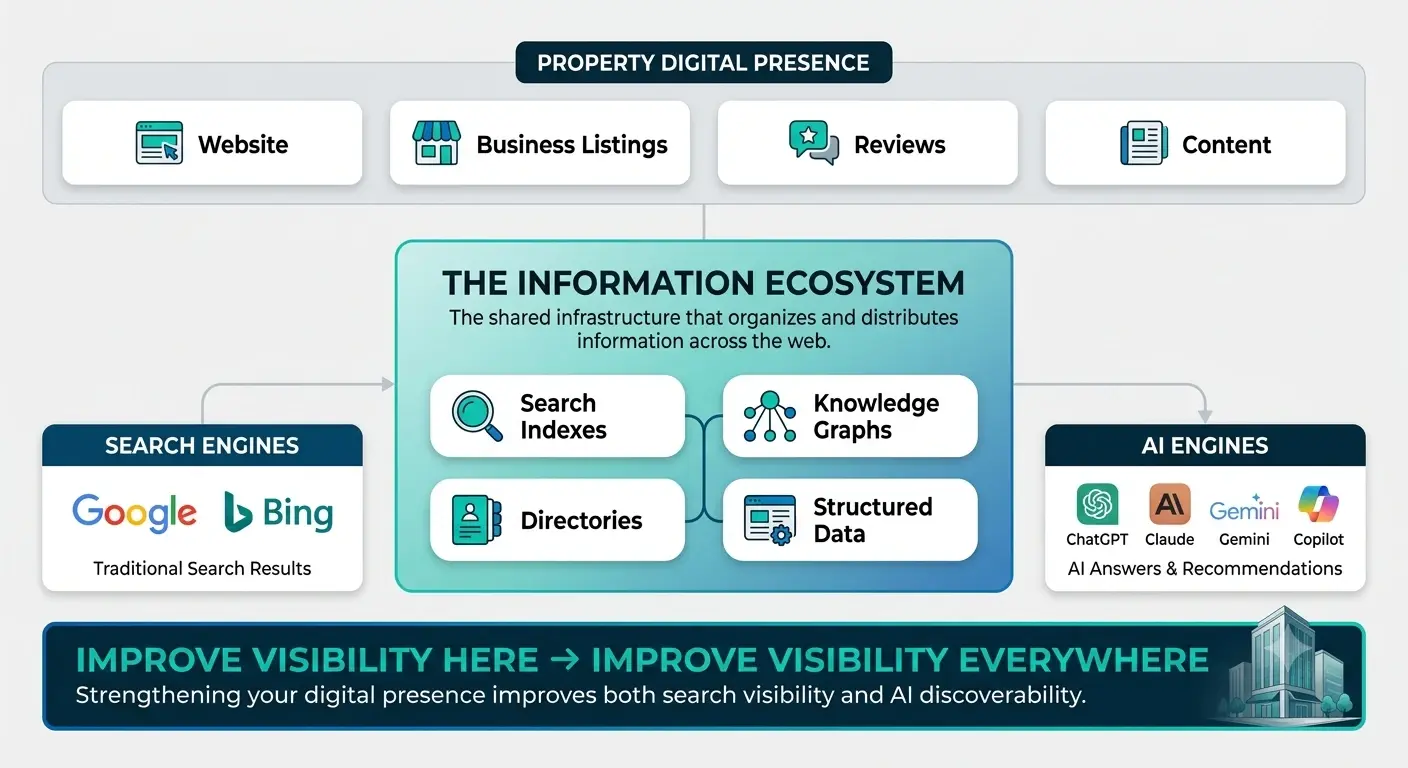
Instead, they operate as highly sophisticated retrieval and summarization layers.
OpenAI (the creators of ChatGPT) and Microsoft are attached at the hip via Microsoft taking a large minority stake in OpenAI in 2023.
Because of that partnership, both ChatGPT and Microsoft Copilot rely heavily on Bing’s index alongside their own specialized scrapers
They tap into systems like Bing Merchant Center for live product and inventory feeds (commonly used in ecommerce).
But what people don’t know is that ChatGPT also utilizes scrapers (like SerpApi) to actively scrape Google’s live search results.
In fact, recent industry research highlighted by Bizibl Commerce proved that ChatGPT is openly pulling data directly from Google Merchant Center feeds to answer consumer queries about products.
Even though Merchant Center product feeds aren't directly utilized in real estate (yet), this cross-platform scraping proves an important point.
It means that ChatGPT is actively combining what they pull from both Bing and Google to return and summarize its results.
At the end of the day, as Dennis points out, AI models are pulling from the exact same upstream data pools that search engines have used for years.
If your asset's website is invisible, difficult to navigate, lacks authority, or is unhelpful to users in any way in primary search indexes like Google and Bing, there’s no chance that tools like ChatGPT or Claude are going to recommend you.
Passage-Level Extraction: Lazy Content Finally Gets Penalized
Let’s be completely blunt for a minute:
If a website is losing organic traffic on Google right now, it isn't because AI Overviews "killed the click-through rate."
While that is an incredibly common complaint we hear, the timeline doesn't match.
In reality, we’ve seen shifting click-through rates across real estate assets dating all the way back to late 2022 (long before Google deployed AI Overviews).
The disruption wasn't caused by AI Overviews suddenly appearing.
Instead, it was triggered by the Helpful Content Updates, which have now been fully integrated directly into Google's core algorithm.
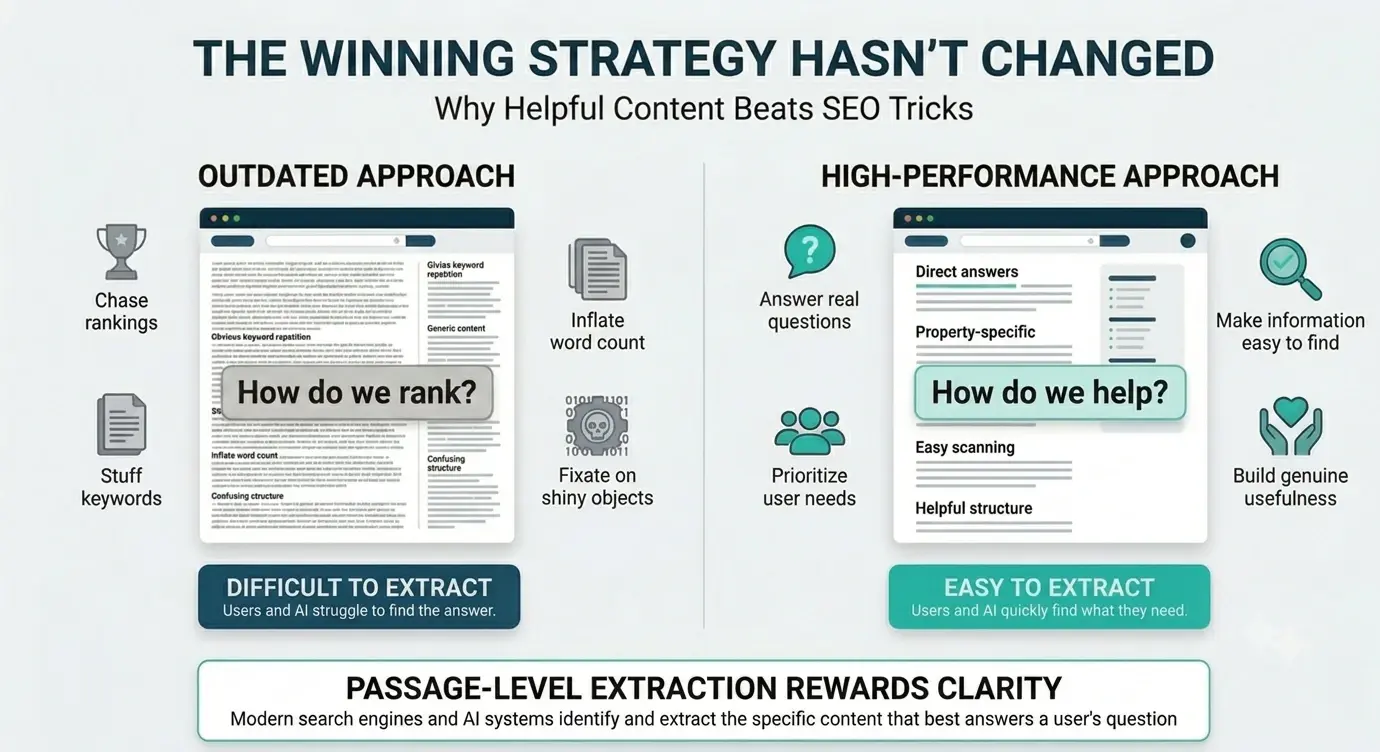
If a site's traffic has been tanking and business results are going with it, it’s almost always because it was built on lazy, subpar marketing content that isn’t genuinely helpful to users.
The algorithms are simply penalizing that lazy execution harder than ever before.
For years, low-quality sites survived by stuffing keywords, dragging out arbitrary word counts, building spammy backlinks, and burying the actual answer to a user's question so far down the page that it effectively served no purpose.
They coasted by on raw backlink volume while providing zero real utility to the person searching for a solution.
The entire legacy approach was built on a flawed mindset:
“We’ve gotta rank #1.”
That phrase directly translates to:
“We are here to game a search engine into ranking us.”
When in fact, the game that high-performance operators should have been playing all along is:
“We need to deeply understand our users and be incredibly helpful to them.”
To prove how long this standard has been the actual baseline, look back at this classic 2019 Q&A session with Martin Splitt, a top Developer Relations Engineer at Google:
While the digital marketing game has evolved significantly since 2019 and tactical details like ranking mechanics are different, the core foundation Martin teaches is still incredibly relevant today.
His advice was simple:
Focus entirely on being helpful to your users.
If your web assets help users accomplish their specific purpose better than other websites, you stand a really good chance of earning their click and their business.
Fast forward to today, and modern search algorithms and LLMs are enforcing that exact rule using a technical framework called Passage-Level Extraction.
Instead of evaluating an entire page as one big block of text, the algorithm reads your website on behalf of the user, parses the structure, and pulls out the correct context that resolves the user's specific intent.
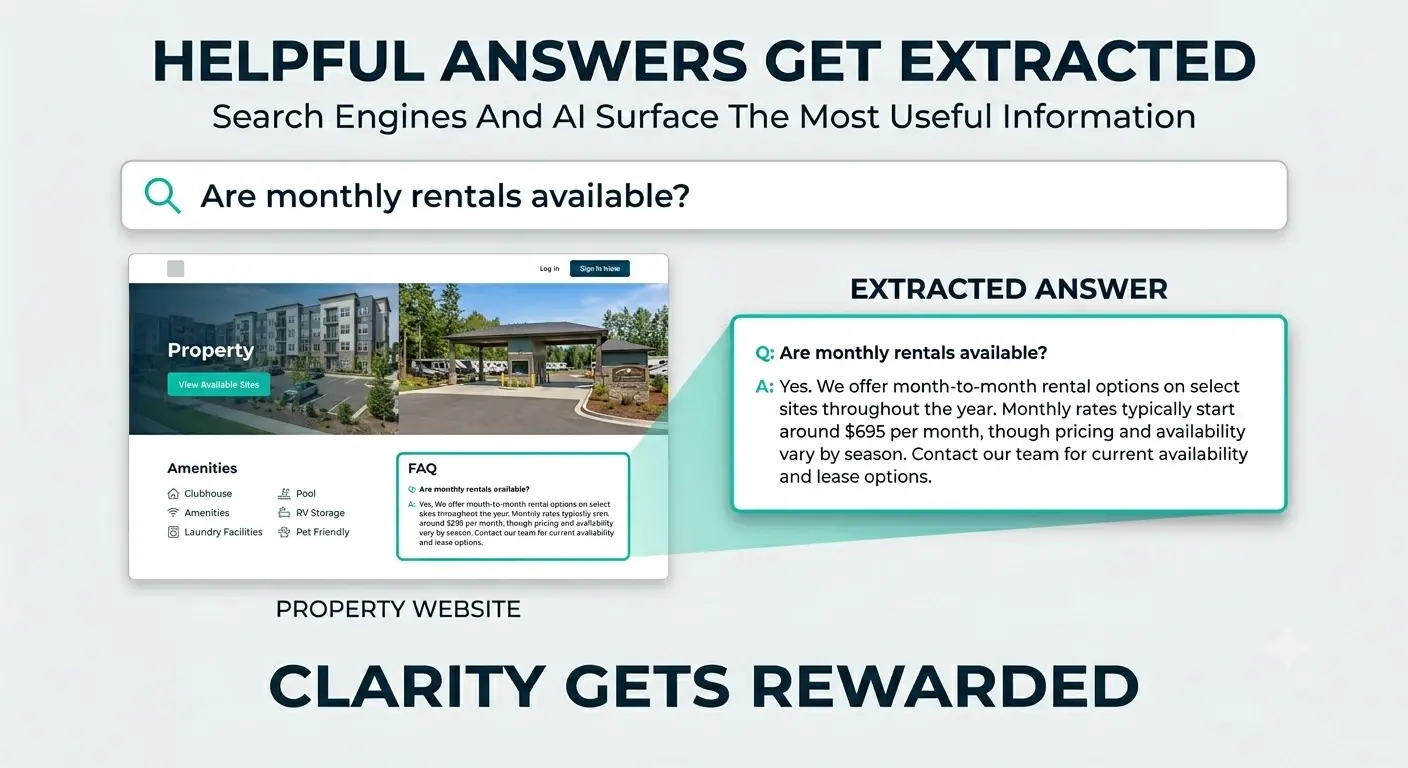
When Google's Helpful Content updates rolled through, high-performance web assets that were already built to cleanly and directly answer user questions saw very little (if any) negative disruption.
The vast majority of heavily impacted sites were built on lukewarm, unhelpful text that was solely designed to manipulate search rankings.
AI didn't change the underlying physics of search marketing.
It just gave search engines a smarter tool to permanently penalize lazy execution.
The "Secret" AI Formula: What High-Performance Marketers Have Been Doing All Along
If your definition of SEO for the past ten years was limited to:
…then yes, the game looks radically different today.
All of these are, frankly, just a substitute for driving actual business performance.
But if you actually understood what organic promotion was always supposed to be, very little has changed.
True organic search has always meant building technically clean site architecture, ensuring all of your listings are detailed and above all creating content that is genuinely useful.
That’s simultaneously really simple and really difficult to pull off.
But the debate shouldn't be about how to trick an AI tool into recommending your property.
The only question that matters is:
"Is our website / listing / ad / etc. structurally and contextually authoritative enough that an AI retrieval engine can easily identify us as the best solution for the consumer’s problem?"
To an AI engine, structural authority means your digital infrastructure isn't a tangled mess.
It means that you’ve organized the following so cleanly that a machine can easily scan them and not have to guess:
Contextual authority means you aren't hiding behind the same generic, AI-generated text that everyone else is using.
It means your content possesses real utility and cleanly answers key questions a prospective tenant or guest actually cares about when evaluating your property.
To win this game, you don't need a huge team or a completely new line item in your marketing budget.
High-performance operators win by focusing on a scannable, clean, and truly useful technical setup.
Industry analyst Kevin Indig reviewed 1.2 million ChatGPT responses to see what triggers an AI model to cite a website. He found that legacy vanity metrics and manufactured popularity signals had almost zero impact on what the machine recommended.
Instead, the data showed that 44.2% of all AI citations are pulled directly from the first 30% of a page's content, and sites that formatted their data in clear, direct Q&A blocks were twice as likely to be recommended.
AI Citations Pull From
First 30% of Content
30% - 70% of Content
Final 30% of Content
It's not magic.
The machine is literally just scanning the top of your page for clear, un-bloated answers to a user's question.
Here is a side-by-side checklist of what you can safely ignore versus what your engine needs to focus on:
The AI Engine Checklist
What You Safely CAN Ignore | What You Must Absolutely NAIL |
|---|---|
Buying specialized "AEO/GEO Optimization" tools or service retainers | Fast websites, lean crawl budgets, clean site architecture, and solid technical foundations |
Publishing loose, generic, "AI-friendly" text that doesn’t actually solve the user’s intent | Direct, passage-level clarity that satisfies user intent |
Worrying about custom markdown or chunking rules | Establishing ironclad data sovereignty |
Chasing arbitrary rankings (they’re not even a thing in AI tools) | Ensure you have AI User Agents set to “Allow” so they can access your site (instructions below) |
Unlocking the Gates: Giving AI Engines a Green Light to Access Your Website
Real estate operators don't run million-page sites like many ecommerce or enterprise websites.
Whether you own multifamily assets, RV resorts, self-storage or any other rentable asset your website is likely a highly focused, detailed set of 25 to 50 high-value pages.
You are showcasing:
Beyond writing clear, direct answers about your property’s features and checking all of the technical features all websites must have…
…one of the simplest and highest-leverage technical checks is ensuring that AI models have explicit permission to access and read your website.
To ensure your relevant data is fully accessible to every major LLM pipeline, you need to make sure your site's robots.txt file isn't accidentally blocking the future of search.
NOTE: robots.txt is a file that provides explicit directions on how you want search engines to treat parts or all of your site. You should be very careful when editing your robots.txt because it can have unintended consequences. A good developer will know how to help you navigate this safely.
Add this clean, direct user-agent block to your root directory to give the primary AI engines an open green light to crawl your website:
# Give the major AI bots explicit access to read your property data via your robots.txt
User-agent: GPTBot
Allow: /
User-agent: ClaudeBot
Allow: /
User-agent: PerplexityBot
Allow: /
User-agent: Google-Extended
Allow: /
This is the largest technical step you need to follow to ensure your website is accessible and understandable by AI tools.
The rest is back to great marketing and ensuring your website is incredibly helpful to users.
The Illusion of Search Engine and AI “Rankings”
The entire reason so many businesses are currently panicking over marketing with AI is that they have been conditioned to look at the wrong measuring stick.
Most operators treat organic search like a universal, winner-takes-all leaderboard where you are either "ranking #1" or you are invisible.
But the reality is much more nuanced than this.
In an era of:
A single universal "Page 1" ranking simply no longer exists.
In fact, it hasn’t for quite some time.
And when you add the new layer of generative AI into the mix, search becomes even less about static rankings than it ever was.
The fact of the matter is, you can:
- Sit on the same couch as a colleague
- Connect to the same Wi-Fi network
- Search an identical query or prompt….
…and receive completely different results based on your individual user context.
Because of this, it's incredibly common for clients to review reports from 3rd-party SEO tools (e.g. SEMRush, Ahrefs, etc.) and panic over a notice showing that their “rankings” have shifted for specific keywords.
While 3rd-party SEO tools are great for broad research purposes and can provide some interesting insights, you have to remember a very critical technical point:
3rd-party SEO tools do not have a direct connection to Google's or Bing's actual live indexes
Instead, they use independent bots to sample what data they can extract, extrapolate positions, and provide you with an estimate of what they think your actual rankings in a search engine might be.
Unfortunately, this also means that these software platforms regularly invent metrics (like "Domain Toxicity") that the actual search engines don't even use.
In our experience, these metrics often serve little purpose other than to create anxiety and justify your ongoing software subscription with them.
They almost never align with the raw data found in direct, first-party platforms like Google Search Console or Bing Webmaster Tools, which show you the actual health and technical performance of your website.
The same is true with the concept of traditional rankings.
They’ve become nothing more than an emotional comfort metric you can look at to feel good.
Always remember:
Digital marketing success isn't defined by an estimated number on an artificial leaderboard
It is measured in captured demand, qualified lead volume, booked business, and ultimately, maximizing your property’s Net Operating Income (NOI) and overall profitability.
NOI > Vanity Metrics
If your marketing doesn't directly impact conversions, lead volume, bookings or leases and ultimately asset value, it’s just a comfort metric.
You should instead focus on metrics that matter to the performance of your property such as lead velocity & quality, leases / bookings, and ultimately improvement in your NOI.
You’ll save a significant amount of money and wasted time by simply walking away from software and agencies that bill you for where you "rank" on a leaderboard that doesn't exist.
The challenge isn’t understanding these concepts.
Most operators grasp them quickly once they’re explained.
The challenge is objectively evaluating whether your property’s digital infrastructure, marketing strategy, and measurement systems are all working together to produce the occupancy, lead volume, and revenue outcomes you’re looking for.
If you’re ready to stop chasing comfort metrics and get an honest review of where your property’s digital infrastructure stands today, you can request a customized audit of your property’s online presence by clicking the button below.
We will:
We’ve engineered systems that systematically close these gaps by taking the complex burden of technical architecture, data sovereignty, and full-funnel optimization entirely off your plate so you can focus on running your property.
Let's Improve Your Occupancy & NOI
Ready to audit your property's digital infrastructure? Let's identify the hidden revenue gaps in your current setup.
Your Next Steps: Stop Chasing Shiny Objects & Just Focus on Creating Amazing Online Experiences
Your digital marketing engine should never be built on chasing rankings, short-term algorithmic hacks, or reacting to industry panic about AI.
High-performance strategy is built entirely on creating stable and lasting technical assets that deliver exceptional value to your users.
Here's what is and is not going to help you in those efforts
You Can Safely Stop... | ...And Instead StarT TO |
|---|---|
Stressing over (weekly) new acronyms or giving into the never-ending AI hype | Build solid, reliable conversion & lead tracking to protect your data sovereignty |
Chasing arbitrary rankings | Ensure your website explicitly allows AI agents to access it |
Trying to game search engines & AI platforms | Keep a clean technical website architecture |
Searching for where your property ranks against certain keywords | Optimize for omni-channel (being present everywhere your users are) |
Buying services that treat AI optimization as a completely separate discipline from technical SEO, content strategy, and user experience. | Create a meaningful marketing strategy that gets updated as needed |
Trusting in comfort metrics that don't contribute to business outcomes | Focus 100% of your energy on building clean, useful online experiences that make your real estate asset the obvious choice for your customers |
Over To You
It’s your turn.
What did you learn about AI in marketing that you didn’t know before? Are you still tracking keyword rankings or are you moving toward tracking real, measurable business results? Have you audited your website content to see where you can improve? If so, what have you discovered?
We’d love to hear from you, so drop your thoughts, experiences, and questions in the comments below.
Let’s get into it!
Until next time,
Bryce
